Mozart Revisited

Last weekend I was in Arizona to sing Mozart’s grand C Minor Mass with Tucson Chamber Artists. It was a musical homecoming, and a chance to reflect on how far we’ve all come in the last seven years.

TCA concert poster

The last time Tucson Chamber Artists (TCA) did the C Minor Mass was in November 2006. It was an ambitious project for TCA and director Eric Holtan — the first large-scale concert for the upstart group then in its third season — and there was a lot of good publicity and excitement in the community in anticipation of the concert.

I sang in that performance, where the soloists stepped out from the choir and the pickup orchestra was made up of some of the best professional and grad student players in town. It was my second season singing with TCA, and I was used to seeing 50-100 people at each performance. We filed into St. Michael and All Angels church to begin the C Minor Mass and were overwhelmed to find ourselves facing a standing-room-only crowd. The excitement inspired everyone to give a thrilling performance, and the audience responded by leaping to their feet in appreciation. I remember getting teary during the final bows for applause that seemed to go on forever. That concert launched TCA as a force in the Tucson music community.

The concert helped launch my solo career, too. In 2006 I’d just finished grad school at the University of Arizona and was beginning to make my way as a professional. I’d had only a handful of opportunities to solo with an orchestra, so I was excited when Eric asked me to sing the “Et incarnatus est.” Here’s Barbara Bonney, one of my heroes, singing it:

I don’t think I knew then how difficult the piece was, and just concentrated on managing my breath as I spun Mozart’s impossibly long, luscious phrases. The ecstatic review we got for that concert (you can still read it online here) was my first personal review, and I still sometimes use the “glorious high notes” quote in my bio.

So here we were seven years later, marking Tucson Chamber Artists’ 10th season with another performance of the C Minor Mass. Now TCA has glossy programs, a CD produced by GRAMMY-winning producer Peter Rutenberg about to be released, and the kind of budget that allows Eric to bring freelancers like me into Tucson for projects. Now I fly around the country performing with orchestras and chamber groups, and have quite a few reviews to my credit. I’ve sung the Et incarnatus est in auditions and competitions — including at Carnegie Hall in this year’s Oratorio Society of New York’s Solo Competition finals — in the years since, but always with piano. This was my first crack at it with orchestra since 2006, and I’ve figured out a few things technically in the past seven years.

Everything came together easily this time. Rehearsals were a breeze. All the musicians were in good moods and excited for this musical celebration. The performances were truly excellent. Our audiences loved us. I was in good voice and felt like I sang both the meandering lines of “Et incarnatus est” and the crazy low notes of the “Christe eleison” about as well I possibly could. It was the kind of work week — musically, personally, and emotionally satisfying — that makes me marvel at the luck that lets me do what I love for a living.
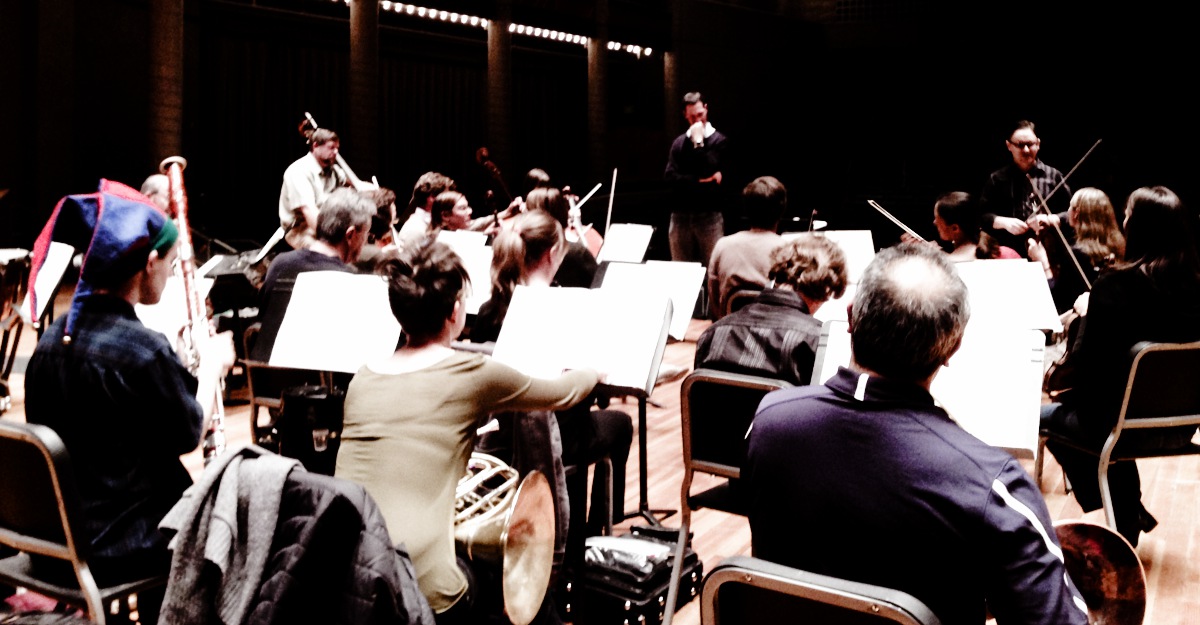
TCA in rehearsalDress rehearsal on Halloween

In the past couple years my mother, who was at some of those very early concerts of Tucson Chamber Artists, has frequently said, “isn’t amazing how far you and Eric have both come since TCA began?” I’ve always agreed, but it didn’t fully hit home until the final minutes of our last performance Sunday. Seven years ago we were good, but this time we were very, very good. Here we were making incredible art for an audience whose love for the music was palpable, and I was surrounded both onstage and in the audience by good friends from different times and places in my life. At the last few bars of the “Hosanna” my eyes welled up, my voice cracked, and I had to drop out of the chorus for a few notes while I got my emotions in check. Every time I perform a great work of music, I wonder if I’ll be lucky enough to sing it again — you never know. To revisit a work under such meaningful circumstances, well, that’s another thing entirely.

Music for a Siege

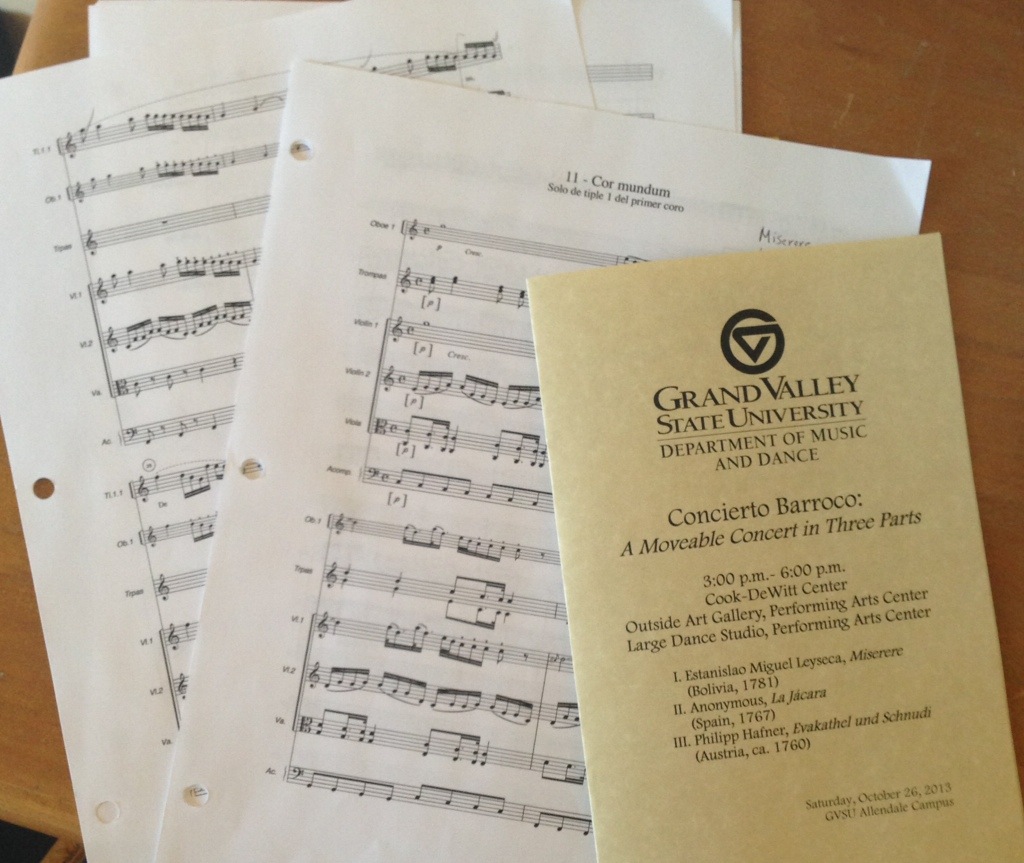
Ever since grad school I’ve been interested in Latin American baroque music. I always jump at an opportunity to sing it, so I was excited when my friend Pablo Mahave-Veglia invited me back to Grand Valley State University in Michigan to perform Bolivian composer Estanislao Miguel Leyseca’s Miserere with faculty and students there.

GVSU early music ensemble

Early European music from Central and South America is a hot topic in the musicology world these days — after all, there’s not much new classical music left to be discovered in the Old World, but scholars are busy digging up manuscripts from church and cathedral archives on this side of the pond, and creating new editions like this one.

Leyseca score and program

The Leyseca Miserere is not actually baroque. It was written in 1781, and that date would place it in the Classical period. However, music from Latin America of that time is a fascinating mix of styles and periods. Because Spanish settlements in the New World were separated from Europe by so much time and space, there wasn’t the same concept of current fashion or of musical elements going out of style. Composers were free to draw on whatever influences and traditions they chose. In the Miserere there were grand choral movements reminiscent of Monteverdi’s great Vespers of 1610, solo movements that made me think of the Mozart C Minor Mass (written one year after Leyseca’s work) I was preparing at the same time, and a little of everything in between. It was wacky, but a lot of fun, kind of like A Musicological Journey Through the Twelve Days of Christmas but for real.

I’m glad I attended the pre-concert lecture by Dr. Bernardo Illari, the musicologist who prepared our performing edition. He gave the context for the Miserere, which Leyseca (who immigrated to Bolivia from Sevilla, Spain) composed during a siege. While a group of the native Aymara people trapped the inhabitants of La Paz inside the city for six months, Leyseca wrote the Miserere as a musical show of strength and European dominance. I had never before thought of the political implications of Latin American classical music. Now I’m not sure what to think about this fascinating music, written and usually performed entirely by Europeans, to subjugate a native population whose land and power had already been stolen.

Dr. Illari’s lecture has given me something to ponder, and not just in the case of Latin American colonial music. Doesn’t so much music throughout the course of history have a political agenda? Performers can get away with ignoring this fact; musicologists can’t. Since I didn’t have all the answers in time for last Saturday’s performance, I decided to appreciate Leyseca’s Miserere for what it is musically — eclectic and charming — to have fun making music with good people, and to enjoy my time in the pretty city of Grand Rapids.

Grand Rapids


In the Air Again

Lately I’ve had the luxury of gigs at home in the Triangle, and it’s been almost eight weeks since I’ve been on an airplane. But today it’s back up in the air. Judging by my trips listing on aa.com, it looks like I’m back to my old tricks, or uh, travels.

20131024-173403.jpg

RDU is a beautiful airport, and its spacious, aviation-inspired lobby welcomed me back this afternoon.

20131024-171048.jpg

It’s back to back gigs in Michigan and Arizona for me, and I have one of those complicated multi-city itineraries that I delight in planning.

I’m a great flyer. I have perfected all the routines and neurotic habits of a frequent traveler. But even for the best of us, even for those lucky enough to have elite status on an airline or two, air travel is exhausting and frequently unpleasant.

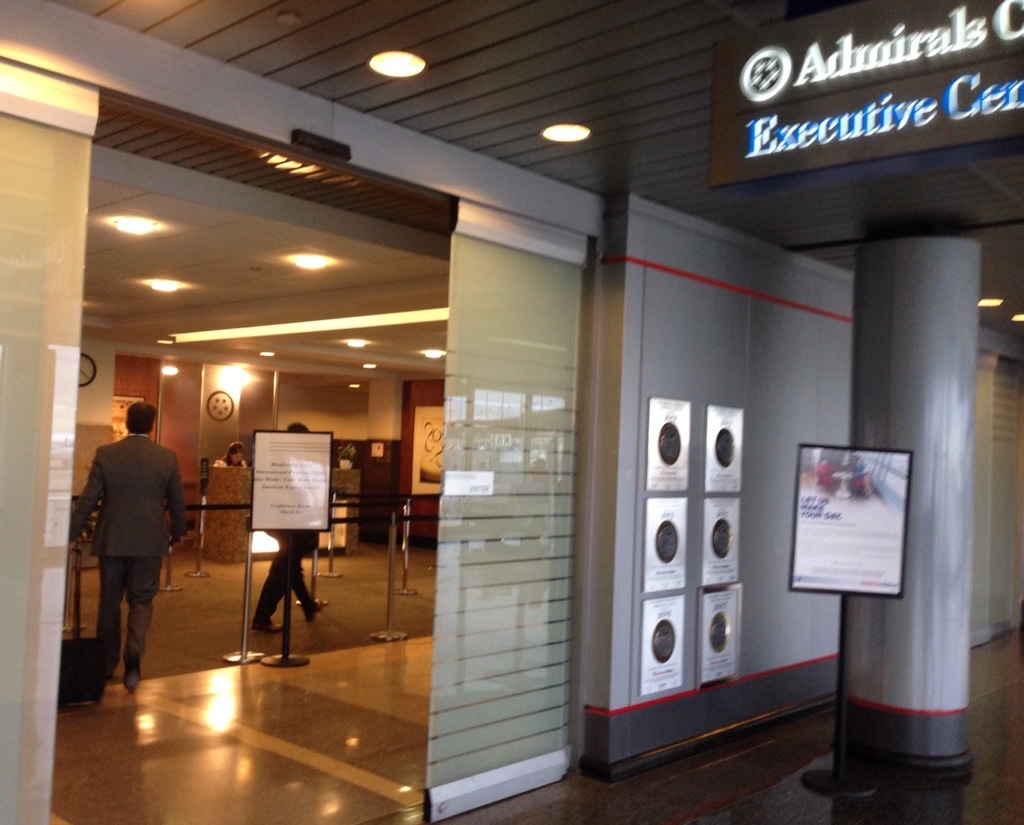
Yesterday American had a flash sale on one-day passes for the Admirals Club, and on a whim I bought one. I decided to use it today because after all, one doesn’t have to jump feet first into the travails of travel, does one?

The glass doors silently slid open to welcome me to an oasis of quiet and free drinks at O’Hare:

20131024-171101.jpg

Where I whiled away a refreshing two hours and enjoyed a Niçoise salad served on a real plate.
20131024-171115.jpg

But now it’s on to Grand Rapids and then Tucson, and some great music at both destinations.

Lucky in Life

How lucky am I, that I get to have a life of music. That’s what I was thinking Saturday night as I drove home from a second day of fun and successful rehearsals with Les Sirènes.

Whenever I get frustrated by the many challenges of a performing career — the travel, the financial uncertainty of stringing gigs together into a livelihood, the pressure of performance, the danger of slipping into professional envy of another singer’s great gigs — I say to myself, “wait, you are making A LIVING doing the thing you love most.” It may not be an easy living, but since I don’t love anything else as much as I love singing, it sure beats doing anything else.

Les Sirenes performance

One of the things that makes all the pressures easier to handle is my colleagues. It’s hard to describe how wonderful it is to be in rehearsal with others who breath music, sharing knowledge and opinions and laughs, or to take the stage in performance together, the electricity between us radiating out into the audience.

Sometimes in the middle of a rehearsal or performance I look around me, and I can hardly believe that I’ve made it to a point in my career when I get to make music at the highest level with other musicians who are leaders in their field.

Knowing so many professionals comes in handy in a pinch, too.

In 2009 I formed Les Sirènes, a Boston-based baroque chamber music group, with my dear friend Kristen Watson. Freelancers have crazy schedules, and it turned out that Kristen and our harpsichordist Michael Sponseller weren’t available for our concert yesterday in Durham. Our cellist Cora Swenson Lee and I made calls to a soprano and a keyboardist we’d worked with in other groups, and we quickly had two very excellent substitutes lined up for the trip to North Carolina.

In just two days of rehearsing with Clara Rottsolk and Dylan Sauerwald we pulled together a polished and moving concert of French baroque music. We were able to work quickly because we communicated so many ideas on the fly without words, and because we enjoyed each other’s company and musicianship so much. Our concert was two hours of joy for me and I think also for our audience, many of whom were moved to tears by our closing piece, Couperin’s luscious Troisième Leçon de Ténèbres.

Regrettably, I did not get a recording of the concert since I failed to ensure there was space on my recorder’s memory card (and oh, am I grumpy about that). But we have the pictures to prove it, and maybe we’ll get to do it again sometime.

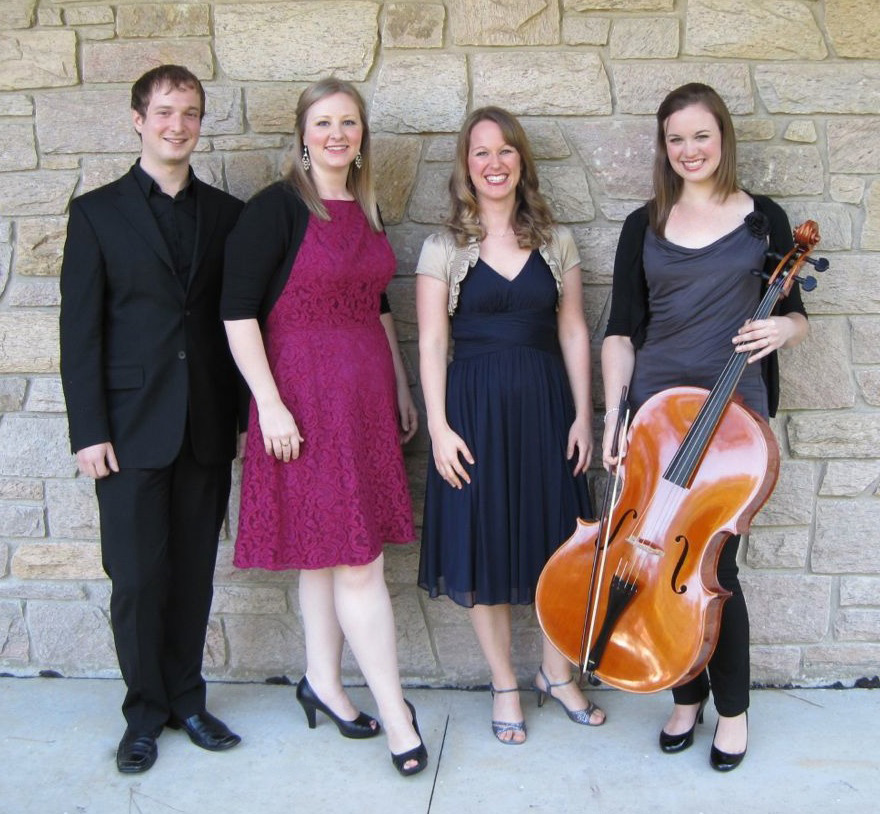
Les Sirenes

Thank you to my gracious and talented colleagues, and to all the people who support my career and the lives of musicians everywhere.

Soprano in the Air does Airbnb

I’m an Airbnb virgin no longer. A couple weeks ago I was Skyping with my friends Alicia and David in London and bemoaning  my 80 mile, gas-wasting drive to Greenville, and David said “you should find a place to stay on Airbnb!” I knew what Airbnb was — a website that connects people with a spare room to rent and travelers looking for a cheap place to stay — but I thought it was only for big cities like London and San Francisco. Not true! I found several listings in Greenville, have friends across the country who’ve had good experiences both renting and staying through Airbnb, and so last week I booked a night to save myself one round trip drive home.

When I got to the door I was a little nervous, and it seemed like my host, who was new to Airbnb and had hosted only once before, was a slightly uncomfortable too. There’s something inherently awkward about walking into a stranger’s house, overnight bag over your shoulder, and being shown to their guest room and told the house rules. But the room was lovely,

airnbnb room

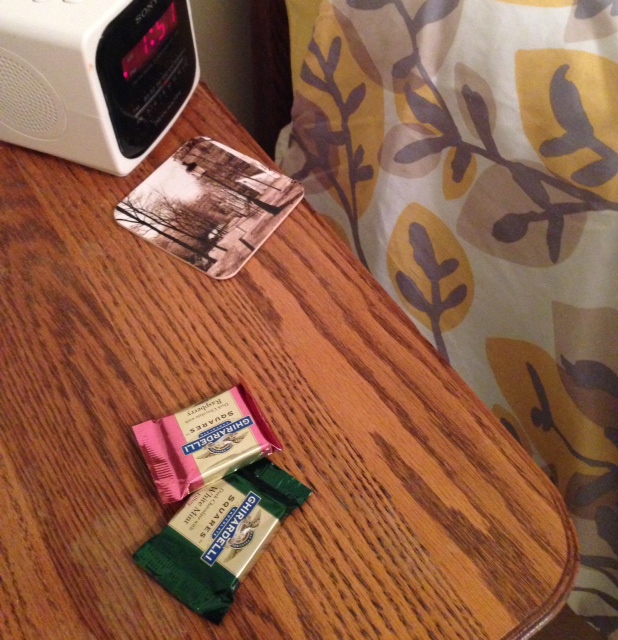
the bathroom immaculate and stocked with fluffy towels, and the bed ridiculously comfortable. There were even chocolates on the nightstand.

chocolate

My host invited me to watch TV with her downstairs so I did, and during commercials we chatted and got to know each other a little. She was nice, it turned out we have similar taste in television, and I got to catch up on the new season of Bones. Then I headed upstairs where I was lulled to sleep by a perfect mattress and the soft sounds of a rainy night in Greenville. All this for about 1/3 of the cost of an equally nice hotel.

The internet is amazing. In so many ways we’re less trusting now, and find the world a more dangerous place than it was a few decades ago. People don’t leave their front doors unlocked, and kids don’t get to run unsupervised all over the neighborhood after school. But you can go online, put in your email address and credit card number, and be welcomed into a total stranger’s house to spend the night. And the consensus is that this usually works out just fine.

And actually, I shouldn’t have found it so strange. I stay with perfect strangers several times a year when I travel for gigs and am placed in home stays. The initial meeting is always awkward, but then I settle into my new temporary home and enjoy learning about my hosts and their lives. I’ve met amazing people this way, and some of them have become close friends. In fact, some of the guests at my wedding were friends I initially met when they hosted me for a performance. It’s a wonderful thing that people, whether they’re doing it as patrons of the arts or to bring in a little extra income, are still willing to open their door and welcome a stranger across the threshold.